
Hail Damage on Your Roof: Repair, Replace, or File a Claim?
On this page · 9 sections
After a hailstorm rolls through Tampa or Sarasota, the calls we get usually start the same way: the roof looks fine from the yard, nothing is dripping, so is there anything to worry about? Sometimes the honest answer is no. But hail damage is sneaky. A bruised shingle, a cracked tile, or a loosened seam can sit quietly for months before a summer downpour finds it — and by then, tying the leak back to one particular storm is a much harder conversation with your insurance company.
We do a lot of hail work, and a lot of work alongside insurance companies, so this post is the walk-through we give homeowners in the driveway: what hail actually does to shingle, metal, and tile roofs, how to read the signs from the ground, when a repair is enough, when the roof needs replacing, and how to keep a claim on track.
The short answer
Bottom Line Up Front
If the hail hits are confined to one or two slopes, the shingles or tiles around them are intact, and the roof had plenty of life left, repair it. If bruising, cracks, or granule loss cover most of the roof, or it was already near the end of its life, replace it — and get it documented before you call your insurance company.
Either way, the first step is the same: get the roof inspected soon after the storm, while the damage is fresh and easy to tie to a date. Our 20-point roof inspection is free, and we photograph everything we find so you and your adjuster are looking at the same evidence.
roof inspection
on our metal roofs
discount
The rest of this post is the reasoning behind that answer, plus a decision matrix near the end that gets most homeowners pointed in the right direction before anyone sets up a ladder.
What hail actually does to a roof
On an asphalt shingle roof, hail knocks the protective granules loose and can bruise or crack the mat underneath. A bruise doesn't always look like much from the street, but once the granules are gone, the asphalt under them is exposed to the Florida sun and starts breaking down faster than the shingles around it. On a tile roof, hail cracks and chips tiles, and a broken tile lets water reach the underlayment it was supposed to protect. On a metal roof, hail leaves dents — and the question there is less about the dents and more about whether the seams, fasteners, and flashing are still doing their job.
Storms rarely hit every side of a house evenly. Wind drives hail at an angle, so the slopes facing the storm usually take the worst of it while the opposite side may barely be touched. That pattern matters, because damage concentrated on one or two slopes is a very different job from damage spread across the whole roof.
How to spot hail damage without climbing a ladder
Start with the soft metal around your home. Dents in gutters, downspouts, roof vents, the fins on your AC unit, a metal mailbox, or a screen enclosure frame tell you the hail was big enough to matter. Check the gutters and splash blocks for a buildup of dark granules. Look for spatter marks on the driveway, siding, or fence where hail knocked off dirt and oxidation. If you see any of that, the roof took the same hits — it just can't show you from down here.
Right after the storm, take photos of dented gutters, damaged screens, and hailstones on the ground with a coin or a ruler beside them for scale. Note the date and time. That evidence disappears fast once the hail melts and the debris gets swept up, and it is exactly the kind of record that helps an insurance claim later.
What you shouldn't do is climb up there yourself. A storm-damaged roof can have loose material, slick surfaces, and soft spots you can't see, and it is no place to learn what a bruised shingle feels like. We've written about why we tell homeowners to stay off the roof, and hail is the clearest case for it. Leave the up-close look to us — a free roof inspection costs you nothing and keeps you on the ground.
Repair or replace after a hailstorm?
This is the comparison we run through on every hail job. Each row is a factor we check; the highlighted column is the smarter call when that factor is the one driving your decision.
| Factor | Lean Repair | Lean Replace |
|---|---|---|
| Roof age before the storm | Plenty of life left | Already near the end of its life |
| Where the hits are | One or two slopes | Most or all slopes |
| Shingle surface | A few bruises, granules mostly intact | Widespread granule loss, exposed mat |
| Cracked or broken pieces | A handful of shingles or tiles | Cracks across the whole field |
| Metal panels | Cosmetic dents, seams and fasteners tight | Opened seams or damaged fasteners |
| Leaks so far | None, or one isolated spot | Water in more than one room |
| Insurance claim | Damage below your deductible | Claim covers the roof |
Every roof is more than one row. The right call is whichever column wins most of your rows, and a free inspection settles the ones you can't see from the ground.
Signs it's a repair, and signs it isn't
A targeted repair is the right answer more often than a door-knocker will tell you. But when hail has worked over the whole roof, patching one slope at a time just spreads the cost of a full replacement across a few more leaks. Here is what puts a roof on one side of the line or the other.
Signs it's a repair
The storm left its mark in a few places, and the rest of the roof is sound. Fix it and move on.
What we look for
- Hits are concentrated on the one or two slopes that faced the storm.
- Shingles around the damaged area still lie flat and hold their granules.
- Only a handful of tiles or shingles are cracked or broken.
- Metal panels show dents, but the seams and fasteners are still tight.
Signs it's a replacement
The hail worked over the whole roof. Patching buys months, not years.
What changes the answer
- Bruises and granule loss show up on nearly every slope.
- Water is coming in at more than one spot in the house.
- Cracked shingles or tiles are scattered across the entire field, not one area.
- The roof was already worn and near the end of its life before the storm hit.
Hail damage and your insurance claim
Hail is the kind of damage homeowners' policies are written for, but a claim is only as strong as the documentation behind it. Get the roof inspected soon after the storm, while the damage is fresh and easy to connect to a date. We photograph everything we find, slope by slope, and walk you through the photos so you know what your adjuster is going to see before they arrive. Coverage depends on your own policy, so read it, note any deadlines it sets for reporting, and don't wait on it.
If you want the longer version, our post on what roof insurance usually covers after a storm goes deeper into the claim itself. And if hail came with wind that tore material loose, our storm damage team can dry in the roof before the next rain does more harm.
After a hailstorm, out-of-town crews knock on doors offering a "free inspection" that finds catastrophic damage in four minutes, then push you to sign before your adjuster has even seen the roof. A roof that truly needs replacing will still need replacing next week. Get the damage documented, file the claim properly, and get a second opinion from a local contractor that runs its own crews — one that will quote you a repair if a repair is what the roof needs, and will still be around when you need the warranty.
If you're replacing anyway: metal roofs and hail
When hail means a new roof, it's worth looking at standing-seam metal. We have our own metal machines and roll our own panels, so we can offer premium metal roofing at prices comparable to shingles, with a 35-year warranty available on metal. Metal can still dent in a hard storm, but a dent in a panel is not the same as a leak — what we check after a storm is whether the seams and fasteners are still tight. For a side-by-side look at the two materials, read our comparison of metal and shingle roofs in Florida.
“Hail rarely makes a roof leak the day of the storm. It makes the roof leak the next time it rains hard — and in a Florida summer, that never takes long.”— Wilson Roofing and Renovations
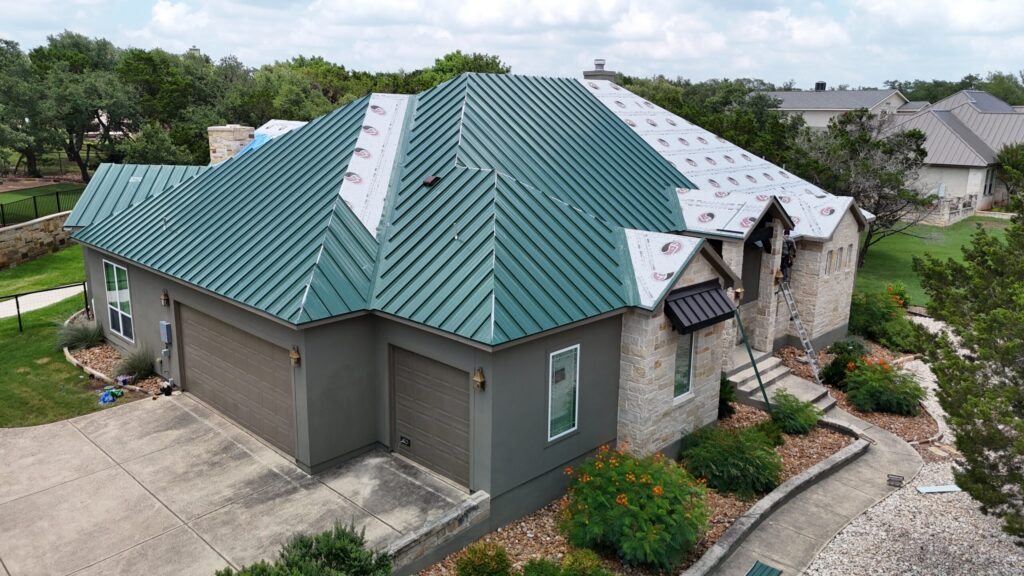
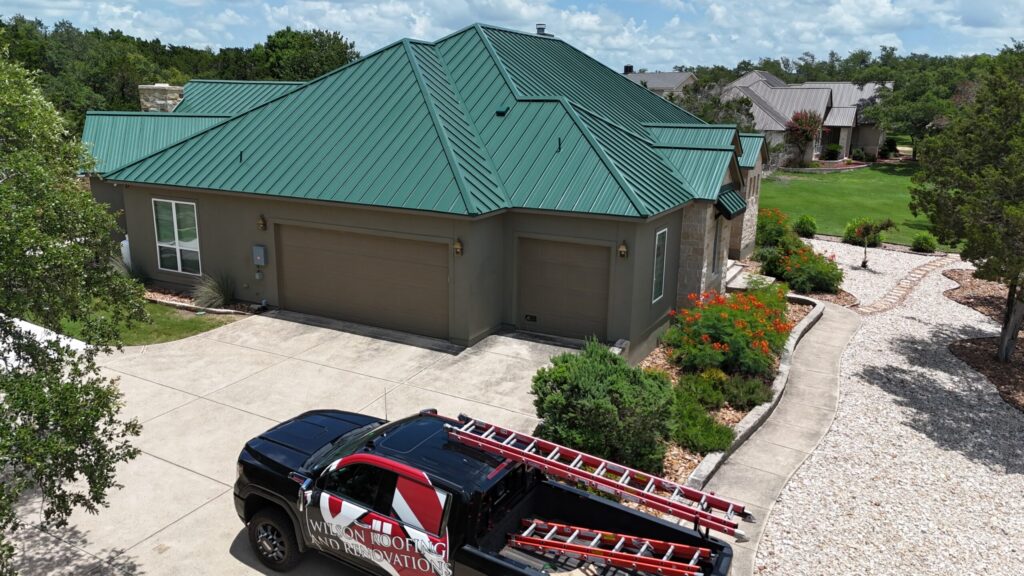
Drag the divider to see a metal re-roof at two stages: dried in under synthetic underlayment, and finished in green standing seam.
The decision matrix
If you only read one part of this post, read this table. Find the rows that match what you're seeing after the storm, then see which column wins. Most roofs land in more than one row — the right call is whichever side wins most of your rows.
| After the storm, your roof… | Repair | Replace |
|---|---|---|
| Shows hits on only one slope | Yes | Overkill |
| Has a few cracked shingles or tiles | Yes | Premature |
| Has dented metal panels with tight seams | Often little needed | Overkill |
| Shows bruising or granule loss on every slope | Stopgap only | Yes |
| Is leaking in more than one room | Too far gone to patch | Yes |
| Was already near the end of its life | Buys time | Yes, usually |
| Has an approved hail claim | If that's the scope | If the claim covers it |
The bottom line
Plenty of roofs come through a hailstorm needing nothing more than a few shingles, a couple of tiles, or a new vent. Others look fine from the yard and are bruised from ridge to gutter. You can't tell which from the ground, and the longer you wait, the harder the damage is to tie to the storm that caused it.
That's what our free 20-point inspection is for. We'll check the roof, photograph what we find, and tell you straight whether it's a repair, a replacement, or nothing at all — even when the honest answer is the smaller job. Book your inspection online or call 941-422-1737. We serve residential and commercial roofs, and military and senior customers get a 5% discount.